Since August 28, 2020, Missouri riders who are 26 or older and carry qualifying health insurance may legally ride without a helmet (RSMo 302.026). Riding helmetless is not negligence by itself, and Missouri’s pure comparative fault rule means a rider can recover even if partly at fault. But insurers raise helmet choice in nearly every motorcycle claim, and you should expect it.
Riders don’t get the benefit of the doubt. The driver who turned left in front of you will say you came out of nowhere. The adjuster will ask about your helmet before asking about your injuries. The case is won with evidence, not assumptions.
What Does Missouri’s Motorcycle Helmet Law Say?
Before 2020, every rider in Missouri had to wear a helmet. House Bill 1963 changed that. Under RSMo 302.026, a rider may go without a helmet if the rider is at least 26 years old and is covered by a health insurance policy or another form of insurance that will pay for injuries from a motorcycle crash. Proof is an insurance card shown on request. Riders under 26, and riders operating on an instruction permit, must still wear one. Officers may not stop a rider solely to check helmet compliance.
Illinois, by contrast, has no helmet requirement for adult riders at all. A rider crossing the river is subject to different rules on each side of it.
Can the Insurance Company Reduce My Claim Because I Wasn’t Wearing a Helmet?
It will try. Missouri apportions fault under pure comparative fault (Gustafson v. Benda, 661 S.W.2d 11, Mo. banc 1983), which means a jury can assign a percentage of responsibility to each party and reduce the rider’s recovery by the rider’s share. The insurer’s argument is that helmet choice contributed to the injuries, so the rider should bear part of the cost.
That argument has limits, and a motorcycle lawyer’s job is to hold the insurer to them:
- Helmet use is only relevant to head and facial injuries. It has nothing to do with a broken leg, a shattered pelvis, a spinal injury or road rash, and those are the most common serious motorcycle injuries.
- The insurer has to prove, usually through a medical expert, that a helmet would actually have prevented or reduced the specific injury. Speculation is not proof.
- Helmet choice has nothing to do with who caused the crash. A driver who ran the light at Hampton and Chippewa caused the crash whether the rider wore a helmet or not.
- Whether, and how, a jury may consider helmet non-use is a legal question your attorney addresses with the court. Do not accept an adjuster’s version of the law.
Why Do Motorcycle Cases Need a Different Approach?
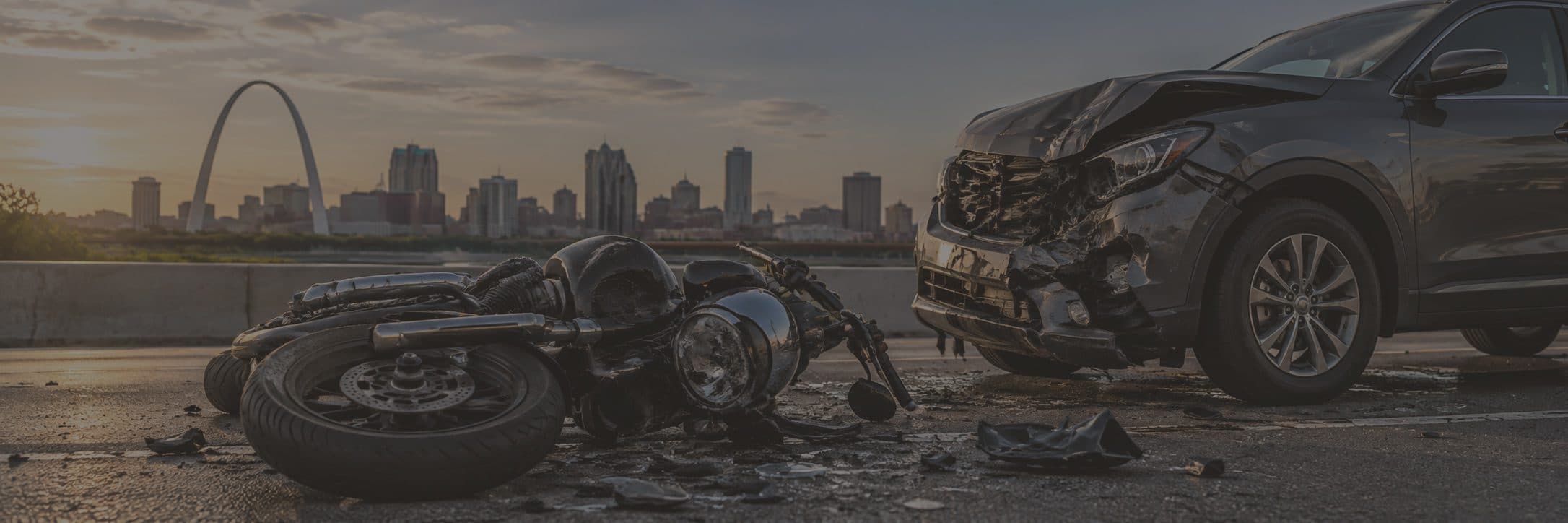
Most multi-vehicle motorcycle crashes involve a car or truck turning left across the rider’s path or changing lanes into the rider. Drivers then report that they never saw the motorcycle. Insurers translate that into “the motorcycle was speeding,” because speed is the only way a visible vehicle becomes invisible.
Answering that requires evidence most people do not think to gather: the length of skid marks, the crush damage on both vehicles, the car’s event data recorder, traffic-signal timing records, nearby camera footage and, increasingly, the rider’s own helmet camera or GPS data. The Injury Counsel retains reconstruction experts in serious motorcycle cases because the physics are what overcome the bias.
What Injuries and Damages Can a Motorcycle Claim Cover?
A rider has no cage, no airbags and no crumple zone. The result is a different injury profile: traumatic brain injury, spinal cord damage, pelvic and femur fractures, degloving and severe road rash, amputation, and long-term orthopedic damage that affects the ability to work. A claim can seek medical expenses, future care, lost income and earning capacity, pain and suffering and the loss of a normal life. Where a rider is killed, the family’s wrongful death claim has a three-year deadline (RSMo 537.100), shorter than the five-year personal injury limit (RSMo 516.120).
What Insurance Pays When a Driver Hits a Motorcyclist?
Missouri requires drivers to carry only $25,000 per person in bodily injury coverage (RSMo 303.190). A serious motorcycle injury exceeds that before the rider leaves the hospital. Your own uninsured motorist coverage, which Missouri requires on every auto policy at the same minimums (RSMo 379.203), and any underinsured coverage you purchased may be the most important policies in the case. We identify every available policy, including coverage on other vehicles in your household, before the insurer tells you what your case is “worth.”
What Should a Rider Do After a Crash?
- Get medical care immediately, even if you feel able to walk away. Adrenaline hides serious injuries.
- Do not discuss your helmet, your speed or fault with anyone but your doctor and your lawyer.
- Preserve your gear, your helmet and your bike exactly as they were. Do not repair the motorcycle.
- Get names and numbers of witnesses. Riders are often alone in a crash with several drivers who saw it.
- Call The Injury Counsel at (314) 727-7220 for a free, confidential consultation. Serious riders deserve serious lawyers who know how these cases are actually fought.