
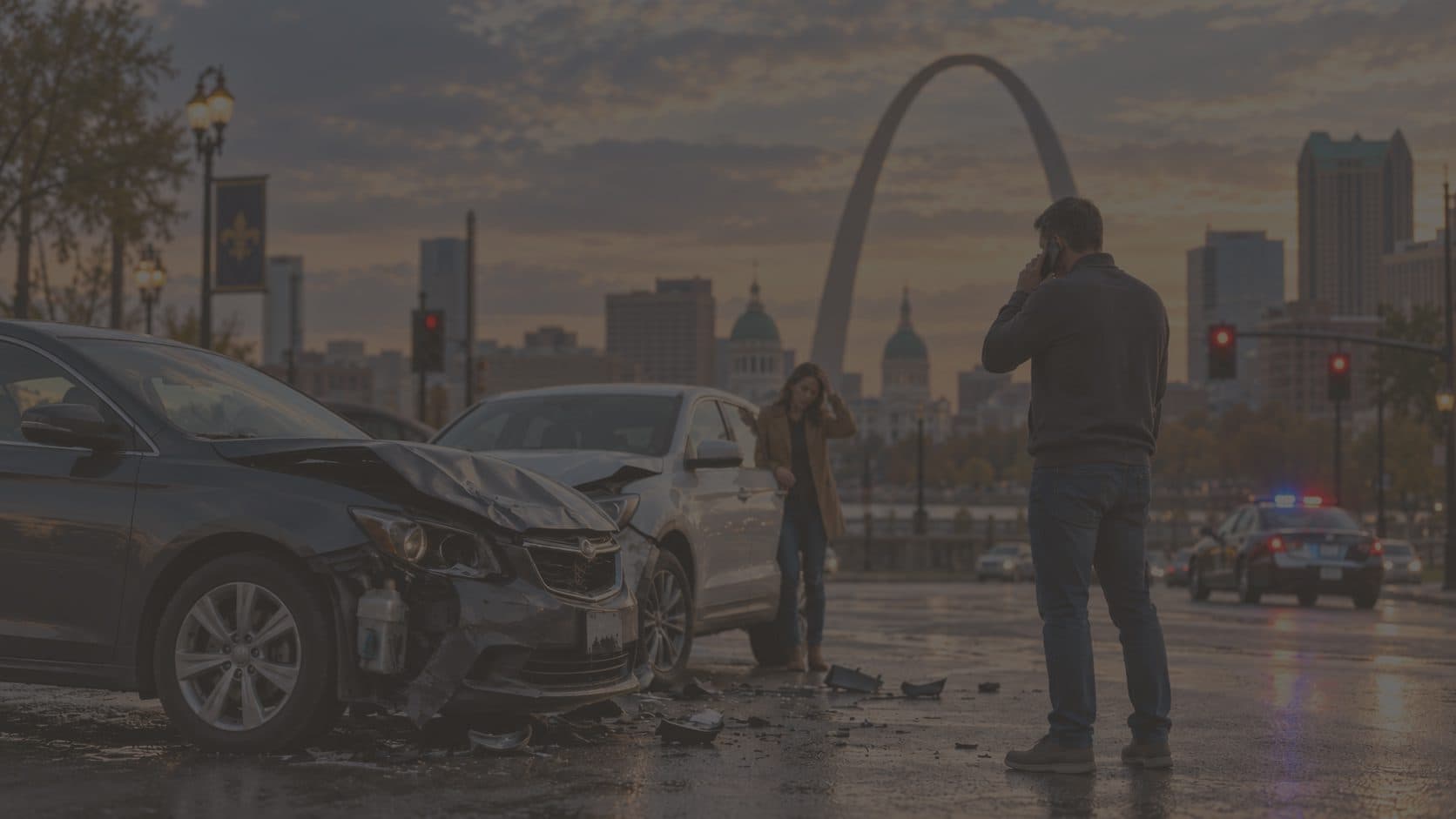
Yes. Missouri uses pure comparative fault, so you can recover even if you were partly or mostly to blame for the crash. Your damages are reduced by your percentage of fault, not erased, and there is no 50 percent cutoff (Gustafson v. Benda, 661 S.W.2d 11, Mo. banc 1983). A driver found 30 percent at fault keeps 70 percent.
Missouri has no 50 percent bar. If an adjuster or an online answer tells you that being half at fault ends your claim, it is describing another state’s law.
What Does Pure Comparative Fault Mean in Missouri?
It means your own share of fault lowers what you recover but never eliminates it. The Supreme Court of Missouri adopted the rule in Gustafson v. Benda in 1983. It replaced the old contributory negligence rule, under which a driver who was even slightly at fault could recover nothing.
The court adopted pure comparative fault as set out in the Uniform Comparative Fault Act, which it attached to the opinion. The operative language is short. A claimant’s fault “diminishes proportionately the amount awarded as compensatory damages” but “does not bar recovery.” There is no threshold. Ten percent, 50 percent and 80 percent are all treated the same way.
Gustafson was itself a crash case. A motorcycle was passing a car near a T intersection when the car turned left. The rule the court announced still governs ordinary Missouri car, truck and motorcycle claims, and it comes from that decision rather than from a statute.
Why Do So Many Sources Say There Is a 50 Percent Rule?
Because most states use a modified rule, and general summaries blend them together. Across the river, Illinois bars a plaintiff whose fault is more than 50 percent of the proximate cause of the injury and reduces everyone else’s damages proportionally (735 ILCS 5/2-1116).
Missouri lawmakers have proposed a cutoff of their own. House Bill 2714, filed in 2026, would have barred recovery for a plaintiff found 51 percent or more at fault. It did not become law. For a Missouri crash today, the pure rule applies.
How Does the Reduction Work?
The jury decides two things separately. First, the total amount of your damages, as if you had no fault at all. Second, the percentage of fault each party bears. The court then reduces your award by your percentage. That is the structure the Uniform Comparative Fault Act lays out, and Missouri adopted it in Gustafson.
Here is an illustration with round, hypothetical numbers. It is not a result, and it does not predict the value of any case.
- The jury finds your total damages are $200,000 and assigns you 25 percent of the fault. Your award is $150,000.
- Same damages, but the jury assigns you 70 percent of the fault. Your award is $60,000. In a state with a 50 percent bar, it would be zero.
- Same damages and 25 percent fault, and the jury also finds, on expert testimony, that not wearing a seat belt contributed to your injuries. The most the court can take off for the seat belt is 1 percent of the $150,000, or $1,500 (RSMo 307.178).
Every percentage point moves real money. That is why the fight over fault starts long before trial.
Who Actually Decides the Fault Percentages?
Only a judge or jury decides fault with legal effect. Before that, other people put numbers on it, and none of them binds you.
The police officer. The crash report records the officer’s view of what contributed to the crash. It is not binding on the insurer, the judge or the jury. A person involved in the incident, or that person’s attorney or insurer, can get a complete, unaltered copy of the incident report on written request (RSMo 610.100). Interstate crashes are often worked by the Missouri State Highway Patrol. Crashes on St. Louis city streets are usually handled by the St. Louis Metropolitan Police Department.
The adjuster. The other driver’s insurer will assign you a percentage, often in its first offer. That number is a negotiating position. It is not a finding, and it is usually set before anyone has gathered the full evidence.
The jury. If the case is tried, the jury is instructed under the Missouri Approved Instructions on comparative fault. The plaintiff-fault instruction begins, “In your verdict you must assess a percentage of fault to plaintiff if you believe,” followed by the specific acts the defense must prove. The verdict form lists each party, and the percentages must total 100. In setting them, the jury weighs both how each party behaved and how much that conduct actually caused the harm.
Both drivers start from the same legal standard. Every Missouri driver must exercise “the highest degree of care” (RSMo 304.012).
How Do Insurers Push Fault Onto the Injured Person?
They look for anything that makes you share the blame, because every point of fault assigned to you comes straight off what they pay. The common moves:
- Speed. The insurer will say you were going too fast to avoid the crash. Speed only counts if it caused or contributed to the collision, and vehicle event data, video and reconstruction often answer that question.
- Phone use. Since August 28, 2023, Missouri drivers may not hold or support a phone while driving (RSMo 304.822). Expect the insurer to ask for your phone records. The same law applies to the other driver, and those records can be requested too.
- Lookout. A recorded statement that you “never saw” the other car becomes a failure-to-keep-a-lookout argument. Do not give a recorded statement to the other driver’s insurer before you talk to a lawyer.
- Seat belts. This is the most overused argument, and Missouri limits it sharply.
Missouri’s Seat Belt Rule
In a Missouri car crash case, not wearing a seat belt “shall not be considered evidence of comparative negligence” (RSMo 307.178.4). It can come in only to reduce damages. The insurer must first introduce expert evidence that the failure to buckle contributed to the injuries you claim. Even then, the reduction cannot exceed 1 percent of the damages awarded, calculated after the reduction for comparative fault.
The rule is different in a claim against a vehicle manufacturer over the vehicle’s design or manufacture. There, seat belt evidence can be used more broadly (RSMo 307.178.5).
In a Missouri crash case against another driver, a seat belt argument can cost you no more than 1 percent of your damages, and only if the insurer brings an expert to prove it.
Does Comparative Fault Apply to Pedestrians and Motorcyclists?
Yes. The same pure rule applies, and insurers lean on it hardest with these two groups.
Pedestrians are blamed for crossing mid-block, wearing dark clothing or stepping out from between parked cars. Those facts can reduce a recovery, but they cannot bar it. The driver is still bound to drive so as not to endanger “the life or limb of any person” and to use the highest degree of care (RSMo 304.012). A driver who should have seen a pedestrian in time to stop shares the fault.
Motorcyclists face assumptions about speed and lane position. Since August 28, 2020, riders 26 and older with a full motorcycle license may ride without a helmet, while riders under 26 and permit holders must wear one (RSMo 302.020). The seat belt cap does not mention helmets, so an insurer may argue that a missing helmet made a head injury worse. That argument needs medical proof tied to the specific injury, and it says nothing about who caused the crash.
What if More Than One Party Shares the Blame?
Then your fault percentage can decide how much of the judgment one defendant must cover. Under RSMo 537.067, a defendant found 51 percent or more at fault is jointly and severally liable, meaning it can be made to pay the entire judgment. A defendant below 51 percent pays only its own share. The jury is not told about this rule. The statute forbids any party from disclosing its impact.
Your own percentage counts toward the 100. A second hypothetical illustration: the other driver is assigned 55 percent, a road contractor 30 percent and you 15 percent. The driver is jointly and severally liable for the whole judgment. Shift 5 points from the driver to you, and the driver drops to 50 percent. Now no defendant reaches 51 percent, and each pays only its own share.
The rule works the same way in rideshare crashes, covered at /car-accidents/rideshare-accidents/, and in highway work zone crashes, covered at /car-accidents/work-zone-crashes/, where a second company is often part of the case.
How Does Fault Interact With the Policy Limits?
Often the policy limit matters more than the fault percentage. Missouri drivers must carry only $25,000 per person and $50,000 per crash in bodily injury liability coverage (RSMo 303.190). When your damages are far above the other driver’s limit, a fault reduction may not change what that policy actually pays.
A third illustration, again hypothetical: your damages are $300,000 and you are assigned 20 percent of the fault, leaving $240,000. If the at-fault driver carries a $25,000 policy and has no other assets, that limit is the practical ceiling against that driver either way. The real questions are what other coverage exists and who else is responsible.
That is where your own coverage comes in. Missouri requires uninsured motorist coverage in auto policies issued in the state (RSMo 379.203), and many households also carry underinsured coverage. Your insurer pays what you are legally entitled to recover from the at-fault driver, so it can raise the same fault arguments. Settling also has consequences. A settlement with one defendant does not release the others, but it reduces your claim against them by the amount paid (RSMo 537.060).
What Should You Do if the Insurer Says You Were Partly at Fault?
- Do not accept the adjuster’s percentage. It is an opening position, not a finding.
- Get the crash report and read the contributing-circumstances section closely.
- Do not give a recorded statement to the other driver’s insurer, and do not guess about speeds or distances.
- Keep your phone records and do not delete anything from the day of the crash.
- Photograph the scene, the vehicles and your injuries, and write down witness names.
- Identify every policy in your household, including uninsured and underinsured coverage.
- Watch the deadline. Most Missouri injury claims must be filed within five years (RSMo 516.120), and the evidence that proves fault disappears much sooner.
Our car accident page at /car-accidents/ covers the rest of a Missouri crash claim, from the deadlines to the insurance.
Being partly at fault does not end your case in Missouri. Call The Injury Counsel at (314) 727-7220 for a free, confidential consultation. We will review the crash report, the evidence and every available policy with you.