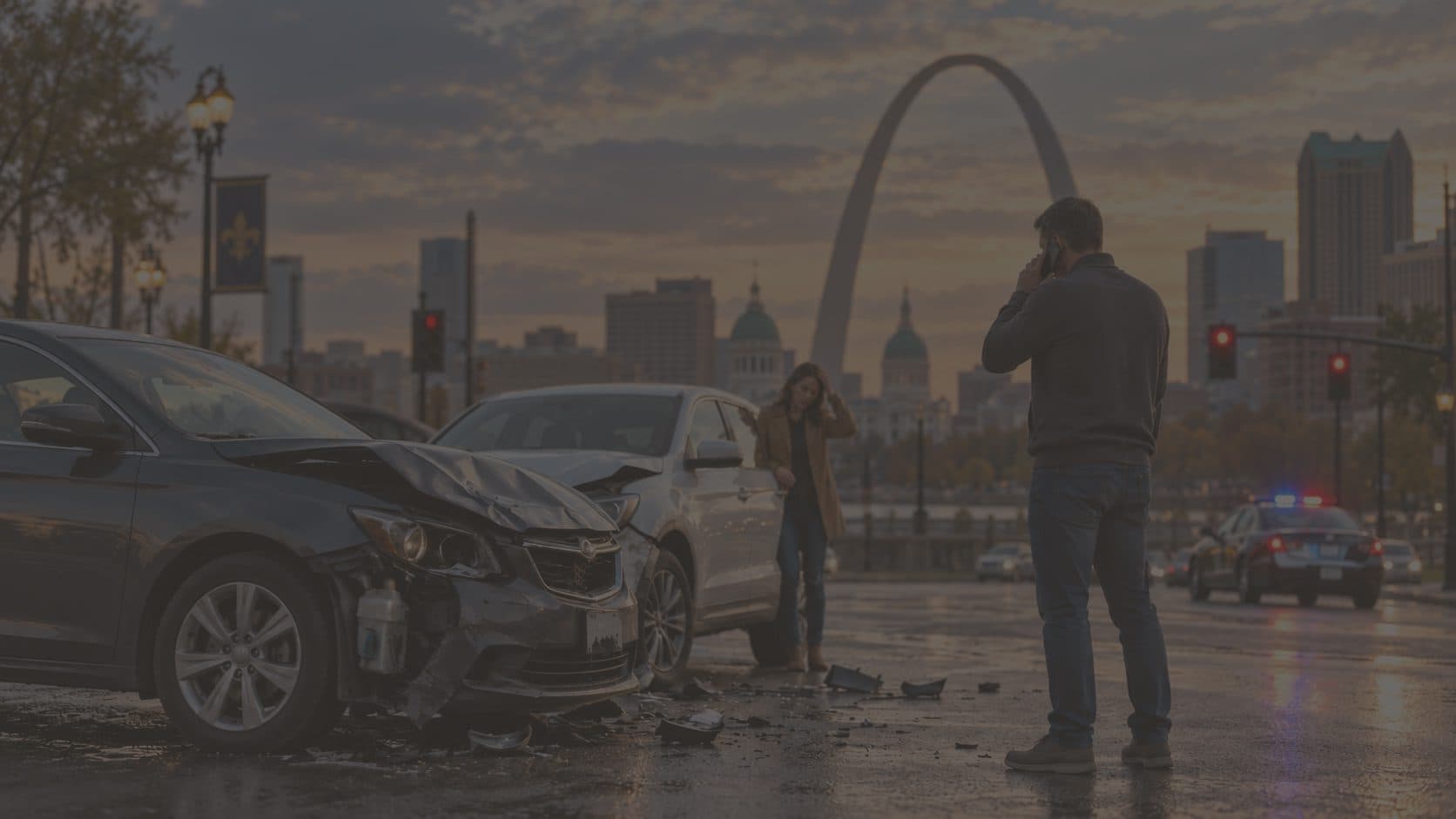
When a Tesla on Autopilot or Full Self-Driving (FSD) crashes, the injured person may have claims against the driver, against Tesla, or both. Missouri’s product liability law (RSMo 537.760) and its pure comparative fault rule let a jury divide responsibility among everyone involved. The deciding evidence is the vehicle’s own data, and Tesla holds most of it.
In August 2025 a federal jury in Miami found Tesla 33 percent responsible for a 2019 Autopilot crash that killed a 22-year-old woman and seriously injured her boyfriend. It awarded $243 million, including $200 million in punitive damages. On February 20, 2026 the trial judge refused to set the verdict aside. Tesla had turned down a $60 million settlement before trial and has said it will appeal.
What Are Autopilot and Full Self-Driving, Legally?
Both are driver-assistance systems. Neither makes the car autonomous, and Tesla’s own materials require the driver to stay attentive and ready to take over. That matters in two directions. A driver who treated the system as a chauffeur can be negligent. And a manufacturer that designed, marketed or deployed a system in a way that foreseeably invited misuse, or that failed to perform as a reasonable driver would expect, can be liable under product law.
Federal safety regulators have open investigations into FSD behavior, and Tesla has settled several Autopilot and FSD injury and death cases since the Miami verdict. The legal landscape is moving quickly, and the facts of each crash determine which theories apply.
Who Can Be Held Responsible?
The Tesla driver
Ordinary negligence. A driver who was looking at a phone, who ignored system warnings or who engaged the feature on a road it was not designed for is responsible the same way any inattentive driver is. The driver’s auto liability policy responds.
Tesla
Missouri recognizes strict liability for products that are defectively designed or that lack adequate warnings (RSMo 537.760), along with negligence claims. In a driver-assistance case the questions include whether the system should have detected the hazard, whether it should have been operable on that road at all, whether driver monitoring was adequate and whether the company’s marketing created expectations the system could not meet.
Others
The other driver in a multi-vehicle crash, a rideshare company if the Tesla was working a platform, or a commercial owner of the vehicle. Missouri’s comparative fault statute for product cases (RSMo 537.765) lets the jury apportion fault among all of them, and the injured person recovers from each in proportion.
Who Are the Victims in These Cases?
- Pedestrians and cyclists struck by a Tesla whose system did not detect them.
- Occupants of other vehicles, including those hit from behind at highway speed or in a crossing-path crash.
- Tesla passengers.
- Tesla drivers themselves, where the claim is that the system failed. A driver’s own comparative fault reduces but does not necessarily eliminate recovery under Missouri law.
- Families of people killed, who have a three-year wrongful death deadline (RSMo 537.100).
What Evidence Decides a Tesla Crash Case?
The car records enormous amounts of data: whether Autopilot or FSD was engaged and when, steering and pedal inputs, warnings issued to the driver, camera footage from multiple angles, speed and braking. Tesla also receives much of that data on its servers. In the Miami trial, the recovery of crash data the company had not initially produced was central to the outcome.
That evidence has to be preserved immediately:
- A written preservation demand to Tesla, identifying the vehicle by VIN and the date and time of the crash.
- A preservation demand to the owner and the owner’s insurer not to repair, sell or salvage the vehicle.
- A forensic download of the event data recorder before the vehicle is moved from storage, where possible.
- A request for the owner’s own vehicle data, which Tesla provides to the owner on request.
- Scene evidence that is independent of Tesla: intersection cameras, other vehicles’ data, 911 recordings and witness statements.
A totaled vehicle is often sold at auction within weeks. Once that happens, the single most important piece of evidence in the case may be unrecoverable.
Does It Matter That Missouri Uses Pure Comparative Fault?
Yes, and it favors injured people. In Illinois, a plaintiff found more than 50 percent at fault recovers nothing (735 ILCS 5/2-1116). In Missouri, fault is simply apportioned (Gustafson v. Benda, 661 S.W.2d 11, Mo. banc 1983). A Tesla driver who relied too heavily on the system, or a pedestrian who crossed mid-block, can still recover from a manufacturer the jury finds partly responsible.
How Long Do I Have?
Missouri allows five years for personal injury claims (RSMo 516.120) and three years for wrongful death (RSMo 537.100). Those are the outside limits. The evidence timeline is measured in days.
Why Call The Injury Counsel?
Driver-assistance crash cases are investigation cases. The company has the data, the engineers and the lawyers from day one. The injured person needs a firm that will move just as fast: preserving the vehicle, demanding the data, retaining the right experts and building the case against every responsible party rather than settling for the driver’s minimum policy.
If you or a family member was hurt in a crash involving a Tesla or any vehicle with driver-assistance features, call The Injury Counsel at (314) 727-7220 for a free, confidential consultation. Do not let the car be sold before we have looked at it.