
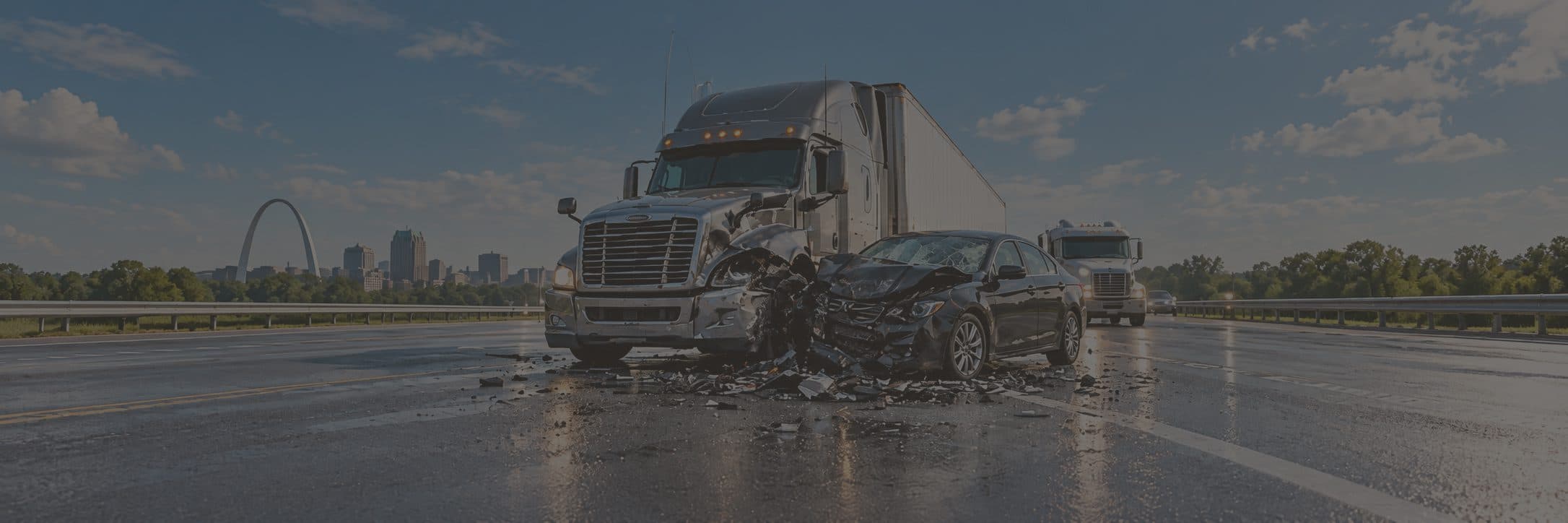
After a Missouri truck accident, you can sue anyone whose negligence helped cause the crash. That usually means the driver and the trucking company. It can also include the truck or trailer owner, the shipper or loader, the freight broker, a repair shop, a manufacturer or a public body. Most claims must be filed within five years (RSMo 516.120).
The driver’s name is on the crash report, but the decisions that put that driver and that truck on the road were usually made by someone else.
Why Does It Matter How Many Defendants You Name?
Because Missouri divides fault among defendants, and each defendant’s share decides what it pays. Under RSMo 537.067, a defendant found 51 percent or more at fault is jointly and severally liable for the whole judgment. A defendant found less than 51 percent at fault pays only its own percentage.
The same statute adds a rule that matters in every truck case. A company is responsible for the fault of a defendant who was acting as its employee (RSMo 537.067.1(1)). The driver’s share and the carrier’s share are counted together against the carrier. Punitive damages are the exception: each defendant pays only the punitive award assessed against it (RSMo 537.067.2).
Each defendant also brings its own insurance. A catastrophic injury can exceed one carrier’s policy, and a company that was never named pays nothing.
Can You Sue the Truck Driver?
Yes. The claim against the driver is ordinary negligence: speeding, following too closely, an unsafe lane change, distraction, impairment or fatigue. Every claim against a company starts with what the driver did wrong.
Federal rules give that negligence a measuring stick. A driver hauling property may not drive without first taking 10 hours off duty, may drive no more than 11 hours, may not drive after 14 hours on duty and must take a 30-minute break after 8 hours of driving (49 CFR 395.3). A driver who broke those rules broke a safety standard written to prevent exactly this kind of crash.
When Is the Trucking Company Responsible?
Almost always, when the driver was working for it. Under respondeat superior, an employer answers for the negligence of an employee acting within the scope of the job. The company that runs the truck under its own federal operating authority is the motor carrier, and it is the central defendant in most truck cases.
The carrier can also be liable for its own negligence:
- Negligent hiring. Putting someone behind the wheel whose record, medical status or experience should have kept them out of the job. Carriers must keep a driver qualification file with the application, motor vehicle records, road test and medical certificate for as long as the driver works there and three years after (49 CFR 391.51).
- Negligent training. Sending a driver out without the skills the load, the equipment or the route required.
- Negligent supervision and retention. Keeping a driver on after violations, crashes or falsified logs showed a pattern.
- Hours-of-service pressure. Federal rules make it the carrier’s own duty to require its drivers to obey the safety regulations (49 CFR 390.11). A dispatch schedule that could only be met by breaking the hours-of-service rules in 49 CFR 395 is the carrier’s failure, not only the driver’s.
How to Find the Carrier and Its Safety Record
Every self-propelled commercial truck must show the operating carrier’s name and its USDOT number on both sides (49 CFR 390.21T). If another company’s name appears on the truck, the carrier’s name must follow the words “operated by.” Photograph the door if you can.
Enter that USDOT number in the Federal Motor Carrier Safety Administration’s free SAFER Company Snapshot at safer.fmcsa.dot.gov. It shows the carrier’s size, its safety rating if it has one, a summary of roadside out-of-service inspections and its reported crashes. A poor record is evidence against the carrier and, as explained below, against anyone who chose it.
What if the Driver Owned the Truck?
The carrier is usually still responsible. Many owner-operators lease their tractor, and their own services, to a carrier. Federal leasing rules require that lease to give the carrier “exclusive possession, control, and use of the equipment” and to make the carrier “assume complete responsibility for the operation of the equipment” for the length of the lease (49 CFR 376.12(c)(1)).
The same rule says it does not decide whether the owner-operator is an employee or an independent contractor (49 CFR 376.12(c)(4)). Carriers point to that sentence. Courts look at the lease terms, the markings on the truck and who actually controlled the trip. The owner-operator can also be named directly, for the driving itself or for a truck it failed to maintain.
The trailer is often owned by someone else, such as a leasing company, a shipper or another carrier. A trailer owner that let the brakes, lights, tires or rear underride guard fall into disrepair is liable for its own negligence. The question is who was responsible for the part that failed.
Can the Shipper or Loader Be Sued?
Sometimes. Federal cargo securement rules require every commercial truck to be loaded, and its cargo secured, so that nothing leaks, spills, blows or falls off and nothing shifts enough to affect the truck’s stability or handling (49 CFR 393.100). Tiedowns must be rated to hold the load against set forces forward, backward and sideways (49 CFR 393.102).
The carrier and driver hold the primary duty for a safe load. Under the rule many courts follow, a shipper that takes on the loading is liable for a defect the driver could not see by ordinary observation, such as cargo braced badly inside a sealed trailer (United States v. Savage Truck Line, 209 F.2d 442, 4th Cir. 1953). The Missouri Supreme Court has not adopted that rule. The federal appeals court covering Missouri has assumed, without deciding, that Missouri would apply it (Aragon v. Wal-Mart Stores East, 8th Cir. 2013).
Shippers and receivers also set delivery windows. Federal rules bar any person from requiring a motor carrier or its employees to violate the safety regulations (49 CFR 390.13). A customer that demanded a schedule only a rule-breaking driver could meet belongs in the investigation.
Can You Sue the Freight Broker?
Yes. A broker arranges the haul for a shipper and picks the trucking company, but does not own the truck or hire the driver. The usual claim is negligent selection: the broker hired a carrier it knew, or should have known, was unsafe.
For years brokers argued that federal law barred those claims. The Federal Aviation Administration Authorization Act preempts state laws “related to a price, route, or service” of a broker, but it “shall not restrict the safety regulatory authority of a State with respect to motor vehicles” (49 U.S.C. § 14501(c)(1), (c)(2)(A)). The federal appeals courts split. The Seventh and Eleventh Circuits held negligent-selection claims preempted. The Sixth and Ninth Circuits let them go forward.
The Supreme Court agreed in 2025 to resolve the split and decided Montgomery v. Caribe Transport II, LLC on May 14, 2026. In a unanimous opinion by Justice Barrett, the Court held that a claim that one company negligently hired another to transport goods falls within the safety exception and is not preempted. It reversed the Seventh Circuit, which had dismissed the claim against the broker.
The decision opened the door. It did not decide the case. The Court did not find the broker negligent and did not set a federal standard for vetting carriers. You still have to prove, under Missouri negligence law, that the broker’s choice was careless.
After Montgomery, a broker’s choice of carrier is a safety decision, and a jury can judge it as one.
Can a Repair Shop or Manufacturer Be Liable?
Yes, for their own failures. When an outside shop adjusted the brakes, mounted the tires or serviced the trailer, and did the work badly, that shop is a separate defendant. The carrier’s maintenance and inspection records show who touched the truck and when.
A manufacturer or seller can be liable when a defective part caused the crash. In truck cases the parts at issue are often tires, brakes, steering components, couplings and underride guards. The claim depends on the failed part itself, so it has to be preserved before the truck is repaired or scrapped.
Can You Sue the Government Over Road Conditions?
Only in limited situations, and with caps. Missouri keeps sovereign immunity but waives it for crashes caused by public employees driving on the job and for a dangerous condition of public property that a public employee created or that the public body knew about in time to fix (RSMo 537.600.1). Damages against a public body are capped, the caps adjust each January, and punitive damages are barred (RSMo 537.610).
Senate Bill 916 changed the rules on August 28, 2026. It treats MoDOT’s private contractors, subcontractors and engineers as MoDOT’s agents, replaces the common-law claim against them with a statutory one and makes MoDOT solely liable for certain injuries tied to its projects (RSMo 537.600.3). Exceptions cover imminently dangerous work, concealed or knowingly undisclosed defects and plans the contractor should have known were unsafe (RSMo 537.600.4). Our work zone page at /car-accidents/work-zone-crashes/ covers the current caps and how project stage affects these claims.
Who Is Responsible for an Amazon or FedEx Delivery Van?
Usually a contractor you have never heard of, and sometimes the brand. Amazon’s Delivery Service Partners are separate businesses. When Amazon launched the program in 2018, it described start-up costs of about $10,000, discounted leases on Amazon-branded vans, a starting fleet of at least five vans and drivers employed by the partner, not by Amazon. FedEx Ground has said that since 2011 it contracts only with incorporated businesses, which treat their drivers as their own employees.
That structure makes the contractor the driver’s employer and the first company liable. The brand can still be a defendant when it controlled the work: the routes, the stop counts, the pace, the in-cab cameras and the driver scorecards. How much control it had is a question of fact, and the answer is in its records. Many delivery vans are rated under 10,001 pounds, below the federal commercial vehicle line (49 CFR 390.5T), so the $750,000 federal floor may not apply. The policies in the chain have to be requested and read.
How Much Insurance Must a Trucking Company Carry?
At least $750,000 for a for-hire carrier hauling ordinary freight in interstate commerce in a vehicle rated 10,001 pounds or more (49 CFR 387.9). The floor rises to $1,000,000 for oil and many hazardous materials, and to $5,000,000 for the most dangerous bulk cargo, such as bulk explosives, bulk poison-inhalation gases and highway-route quantities of radioactive material. These are minimums. Many carriers carry more, and excess policies can sit above the primary one.
A commercial motor vehicle under these rules includes one used in interstate commerce with a gross vehicle weight rating, or actual weight, of 10,001 pounds or more, whichever is greater (49 CFR 390.5T). A loaded tractor-trailer is far above that line.
What Should You Do to Identify Every Defendant?
- Photograph both sides of the truck, the rear of the trailer and any placards, unit numbers or “operated by” markings.
- Get the crash report. Interstate truck crashes around St. Louis are often worked by the Missouri State Highway Patrol.
- Write down the cargo and every company name you saw on the trailer, the cab or the paperwork.
- Do not give a recorded statement to any company’s insurer.
- Keep your own vehicle until it has been photographed and, if needed, inspected.
The records that name the other defendants do not last. A carrier need keep hours-of-service records for only six months (49 CFR 395.8(k)). Missouri gives you five years to sue for an injury (RSMo 516.120) and three years for a wrongful death (RSMo 537.100), but the evidence runs out first. Our article at /blog/evidence-that-disappears-after-a-semi-truck-crash/ explains what the carrier holds and how a preservation letter stops the clock.
Our trucking accidents page at /trucking-accidents/ covers commercial vehicle claims of every size, and our delivery van page at /trucking-accidents/delivery-van-accidents/ goes deeper on Amazon, FedEx and Postal Service crashes.
Every company you leave out is a policy you cannot reach. Call The Injury Counsel at (314) 727-7220 for a free, confidential consultation. We identify every company in the chain and send preservation demands to each one.